


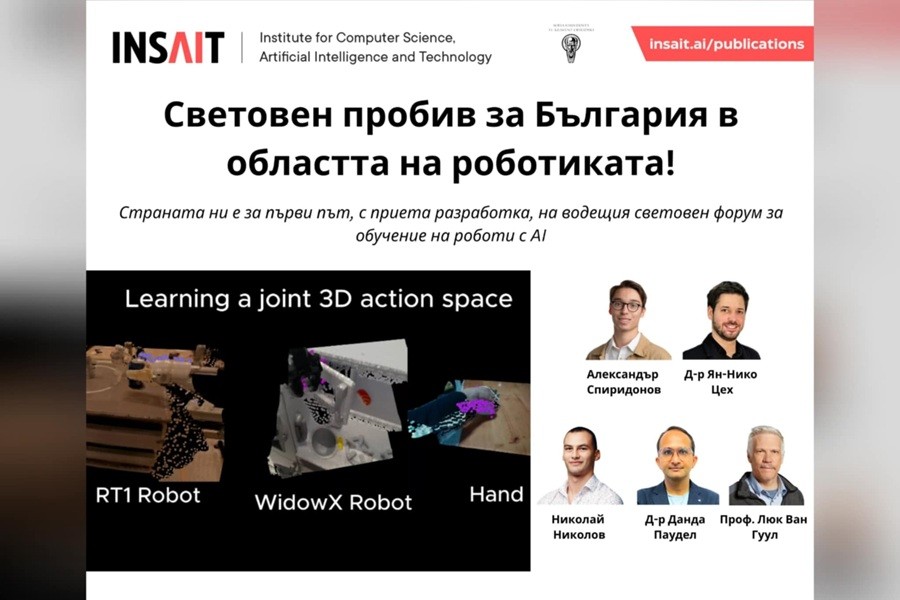
Разработката е приета в CoRL 2025, топ форум за приложенията на AI в роботиката
За първи път в историята на България изследване, разработено в Института за компютърни науки, изкуствен интелект и технологии (INSAIT) към Софийския университет „Св. Климент Охридски“ беше прието и ще бъде представено на Conference on Robot Learning (CoRL) 2025 – водеща световна конференция за роботика, която се провежда от 27 до 30 септември в Сеул, Южна Корея.
Разработката представя MotoVLA – нов подход, който позволява на роботите да се учат не само от данни, подготвени от инженери, но и да се самообучават от обикновени видеозаписи. Така например робот може да наблюдава как човек или друг робот мести предмети и самостоятелно да изведе необходимите движения – подобно на дете, което често научава нови умения чрез наблюдение.
Резултатите показват, че този метод позволява на роботите да се справят по-добре с нови и непознати задачи, правейки ги по-интуитивни и приложими в реални ситуации.
Автори на изследването са изследователите от INSAIT Александър Спиридонов, д-р Ян-Нико Цех, Николай Николов, проф. Люк Ван Гул и д-р Данда Пани Паудел.
Всичко за проекта, вижте тук: motovla.insait.ai
English Version
Historic Breakthrough for Bulgaria and INSAIT: First-Ever Bulgarian Paper Accepted at CoRL 2025

INSAIT announces a landmark achievement: for the first time in history, a Bulgarian institution has a paper accepted at the Conference on Robot Learning (CoRL), a top research conference in robotics. The paper, titled “Generalist Robot Manipulation Beyond Action Labeled Data”, will be presented at CoRL 2025, taking place September 27–30 in Seoul, South Korea.
The work introduces MotoVLA, a novel approach that enables robots to acquire manipulation skills from unlabeled human and robot videos, drastically reducing the need for massive action-labeled datasets. By predicting 3D dynamics directly from video and aligning them to actions with only a small labeled set, MotoVLA unlocks out-of-action generalization—allowing robots to perform completely new tasks without ever seeing their action labels during training.
In rigorous testing, MotoVLA delivered state-of-the-art results, outperforming prior baselines by up to +14.1% on key benchmarks, both in simulation and on real robotic platforms. This breakthrough underscores the potential of combining 3D vision, weak supervision, and robotics to push forward the development of truly generalist robotic systems.
The research team includes INSAIT researchers Alexander Spiridonov, Dr. Jan-Nico Zaech, Nikolay Nikolov, Prof. Luc Van Gool, and Dr. Danda Paudel.
The full paper and project information can be explored at motovla.insait.ai


